How Breastmilk Became Jewelry (and Why It Makes Perfect Sense)
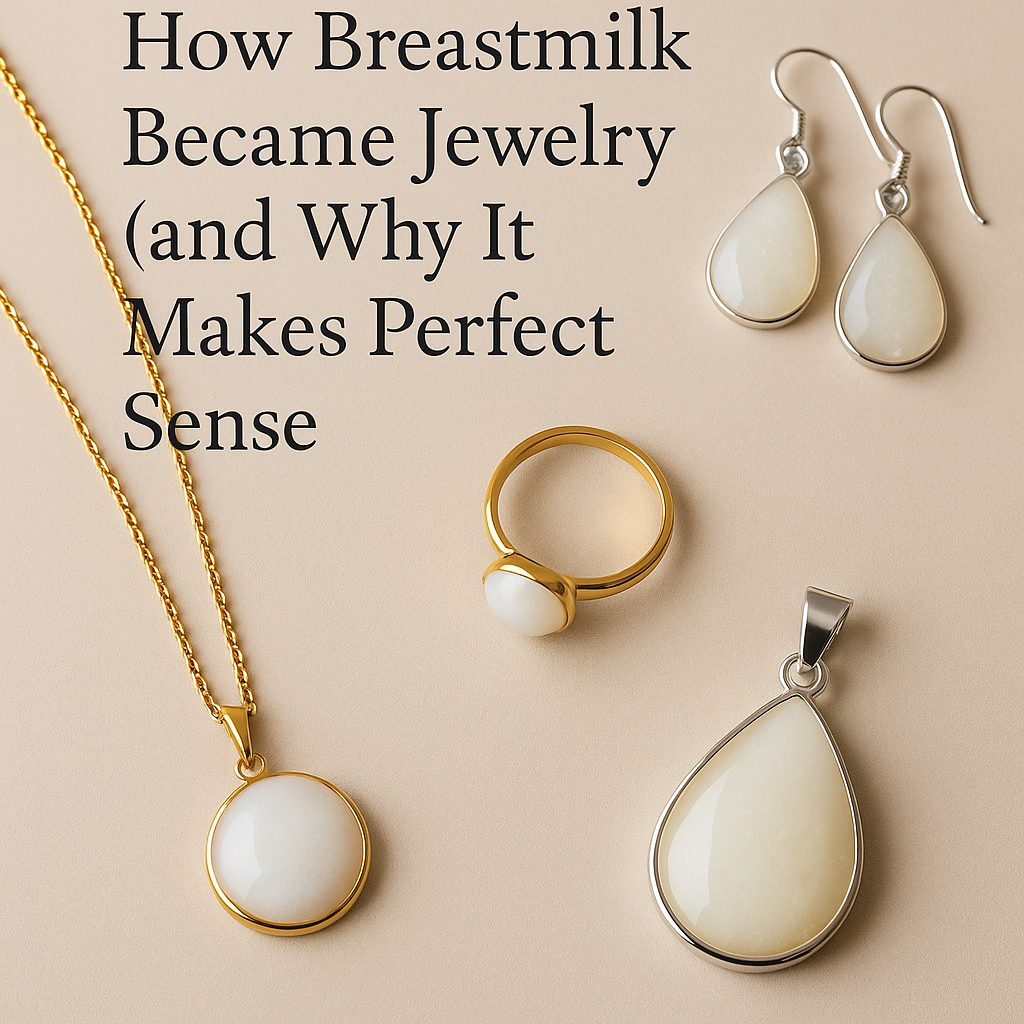
Somewhere between sentiment and science, someone decided to wear their milk.
That's not a metaphor—breastmilk jewelry is a real thing, and it's trending hard.
Mothers are sending small vials of their milk to artisan studios, where it's preserved, mixed with resin, and set into silver, gold, or crystal. What comes back is part keepsake, part relic—a ring, a pendant, or a charm that says: This body once made life.
And honestly? It makes perfect sense.
From Etsy Oddity to Mainstream Keepsake
Breastmilk jewelry started as a cottage niche on Etsy around 2007—the kind of curiosity that made late-night talk shows smirk.
But by 2025, it's become a full-fledged micro-industry.
Companies like KeepsakeMom, Milk Couture Co., and BabyBee Hummingbirds now ship worldwide, transforming milk samples into handcrafted heirlooms. Prices range from $100 to $500, with turnaround times of a few weeks to several months.
Each piece is made from the client's own milk—dehydrated, powdered, and sealed into clear or pearlescent resin that captures the unique color and opacity of their specific milk composition.
What You Can Order:
Rings (often set in sterling silver or gold)
Pendants and necklaces (teardrop, circular, heart-shaped)
Bracelets and charms
Earrings (studs or dangles)
Keychains and ornaments
Custom pieces (incorporating birthstones, hair, umbilical cord)
On the surface, it's sentimental—a wearable love letter to the breastfeeding chapter of motherhood.
But underneath?
It's something much deeper: a reclamation of the body as both creative and sacred.
The Science of Preservation: How Milk Becomes Stone
So how does liquid milk become a permanent keepsake?
The Preservation Process:
Step 1: Sample Collection Customers send 1-2 ounces of expressed milk (fresh, frozen, or refrigerated) in sealed containers.
Step 2: Dehydration The milk is gently heated or freeze-dried to remove water content while preserving the fat and protein structures that give it characteristic color.
Step 3: Powdering Dehydrated milk is ground into fine powder—this is what actually gets preserved.
Step 4: Resin Encapsulation The milk powder is mixed with UV-stabilized epoxy resin (usually 2-part clear resin) and carefully poured into molds or bezels. Air bubbles are removed through gentle heating or vacuum chambers.
Step 5: Curing and Polishing The resin cures over 24-72 hours, then is polished to a smooth, glass-like finish. The result is a "stone"—opalescent, warm, and faintly luminous.
Why It Works:
The resin acts as a time capsule—sealing the milk powder in an oxygen-free environment where bacteria can't grow and light can't degrade the organic compounds.
The fats and proteins remain stable indefinitely (theoretically centuries), though the exact color may shift slightly over decades as microscopic oxidation occurs.
The color varies dramatically based on:
Diet during lactation (beta-carotene creates golden/yellow tones)
Time of day milk was expressed (morning vs evening composition)
Whether it's colostrum (deep yellow/orange) or mature milk (creamy white)
Individual milk fat content
No two pieces are identical—each one is as unique as the body that produced it.
The Meaning Behind the Milk: Emotional Storytelling Through Lactation
What started as a quirky trend is now being recognized as a form of emotional storytelling.
For many women, breastfeeding is both sacred and brutal—it demands, it gives, it transforms. When it ends, there's grief alongside pride.
Breastmilk jewelry captures that transition.
It's not vanity—it's visibility.
What Wearers Say:
"I wanted something tangible to mark what my body did. The nursing relationship was so intimate and so hard—I needed to honor it somehow."
"When I look at my ring, I remember the 3am feeds, the exhaustion, the overwhelming love. It's all in there."
"My milk dried up suddenly after a surgery. I saved what I could and had it made into a necklace. It feels like I'm still carrying that part of myself."
Sociologists have begun writing about breastmilk jewelry as a kind of feminist counter-art: a way of turning the invisible labor of nurture into something tangible, permanent, and self-authored.
In that light, it's less about adornment and more about alchemy.
Why It Makes Perfect Sense: The Cultural Context
We preserve locks of hair, ashes, wedding flowers—even baby teeth.
Breastmilk is just the next evolution of that impulse: to honor what nourished, what passed through us, what once connected us to another human being in the most literal way possible.
Historical Precedent:
Victorian mourning jewelry incorporated hair from deceased loved ones into rings and lockets.
Tooth fairy traditions preserve baby teeth in keepsake boxes.
Umbilical cord preservation is practiced in many cultures (some save the dried cord, others bury it ceremonially).
Placenta encapsulation has become mainstream in natural birth communities.
Breastmilk jewelry sits in this lineage—transforming bodily material into memory artifact.
And if we're being honest:
This isn't just about mothers. It's about the longing to materialize intimacy—to turn care into artifact.
Breastmilk jewelry is physical proof of something most people never see: the cost and beauty of giving yourself away.
The Market of Memory: Where to Get Breastmilk Jewelry
Breastmilk jewelry has moved far beyond handmade Etsy shops.
Major Brands:
KeepsakeMom (est. 2012)
Based in Pennsylvania
Offers rings, pendants, beads
Custom color options
4-6 week turnaround
Prices: $120-$400
Milk Couture Co.
Australian-based, ships globally
Specializes in minimalist designs
DNA helix-inspired settings
Prices: $150-$500
Tree of Life Breastmilk Jewelry
Known for intricate metalwork
Celtic and nature-inspired designs
Combines milk with gemstones
Prices: $200-$600
BabyBee Hummingbirds
Budget-friendly options
Simple beads and charms
Fast turnaround (2-3 weeks)
Prices: $80-$250
What Customers Say:
Reviews are glowing. Most use words like heirloom, closure, and connection. Others call it "weirdly healing."
And maybe that's the right kind of weird.
Beyond Motherhood: Adult Nursing and Milk Preservation
If Nurturing Desire has taught me anything, it's that our relationship to milk is never just physical.
It's emotional, symbolic, even philosophical—a language of giving and receiving that doesn't end at infancy.
The Unspoken Question:
If mothers are preserving milk from nursing their infants, could adult nursing partners do the same?
The answer: Absolutely.
Some couples practicing wet adult nursing have commissioned breastmilk jewelry as:
Anniversary gifts
Relationship milestones
Symbols of their intimate bond
Tangible proof of lactation achieved through induction
The milk doesn't know whether it fed an infant or a partner.
The body doesn't distinguish between "valid" and "invalid" nursing.
And the jewelry doesn't judge.
It simply preserves what was given, what was received, and what connected two bodies in the most ancient human intimacy.
The Science They're Actually Preserving
When you preserve breastmilk in jewelry, you're also preserving:
Human Milk Oligosaccharides (HMOs)
The third-most abundant component
Unique to human milk
Prebiotics that shape gut microbiome
Antibodies (Immunoglobulins)
IgA, IgG, IgM
Customized immune protection
Change daily based on exposure
Different composition morning vs evening
Melatonin in nighttime milk
Cortisol in morning milk
Growth Factors
Epidermal growth factor
Nerve growth factor
Insulin-like growth factor
You're wearing biology. You're wearing evolutionary history. You're wearing the only substance on Earth designed specifically for human nourishment.
No wonder it feels sacred.
A Closing Reflection
So when someone wears their milk, they're not being strange.
They're remembering.
Remembering what their body could do. Remembering the person they fed. Remembering the nights, the exhaustion, the overwhelming biological imperative to give.
And for those of us who understand that nursing isn't just for infants—that oxytocin bonding and milk-based intimacy can exist between adults—breastmilk jewelry whispers something else:
Nurture is not disposable.
What nourished once can be honored forever.
And the milk spirits?
They approve.
Continue exploring:
📖 NURturing deSirE — The guide to milk-based intimacy
🎨 The Milky Way — Comics about milk spirits and desire
💧 Milk Drops — Essays on biology, memory, and connection
With warmth,
Frank Gray


Desire doesn’t disappear with time—it settles, deepens, and waits. In this reflective essay, Frank Gray explores adult nursing in long-term relationships, where milk may no longer flow but warmth, memory, and tenderness remain. A meditation on dry nursing, devotion, and the vow beneath the vows.