Talmudic Tales & Male Wet Nurses: A Short History

History has a marvelous habit of humbling our certainties.
You think you know what a culture does with a body part, and then an old book or a dusty medical report pops up and says, with a grin, "Not quite."
If adult nursing feels like a strange new doorway, take heart: people have been opening similar doors for centuries—sometimes in ways that will make you laugh and sometimes in ways that settle you into a very old, very human truth.
Nurture is adaptable.
Let's begin with stories that look like they belong in a cabinet of curiosities.
The Talmudic Miracle: When Men's Bodies Answered the Call
Ancient religious and legal texts—yes, even those weighty, austere pages—sometimes record odd miracles and survival measures that challenge our assumptions about lactation biology.
One such tale, preserved in the Babylonian Talmud (Shabbat 53b), tells of a widower whose wife died shortly after childbirth. The man was poor and could not afford a wet nurse. In desperation, he placed his infant to his chest—and according to the text, "a miracle occurred and his breasts opened like the two breasts of a woman, and he nursed his son."
Read as literal miracle or as witness to the surprising plasticity of the human body, the story insists on a simple point: Biology can be coaxed, and nurture will sometimes bend the rules to survive.
The rabbis debated whether this was truly miraculous (the minority opinion) or shameful (the majority, arguing it publicly feminized him). But the story survived precisely because it documented something the culture had witnessed: male lactation under extreme circumstances.
This wasn't theoretical. This was recorded because it happened—or because communities believed it could happen enough to preserve the account for two thousand years.
Historical Accounts of Male Wet Nurses: Famine, Desperation, and Adaptation
Move forward a few centuries and geography, and you'll find similarly surprising reports.
18th Century Europe: Men Nursing During Famine
In famine-stricken communities across Europe, desperate ingenuity reconfigured role and expectation. Medical literature from the 1700s documents accounts of men acting as wet nurses, using consistent suckling and stimulation to coax their bodies into producing milk.
Alexander von Humboldt, the explorer and naturalist, reported in 1799 encountering a South American man who nursed his child after his wife fell ill, noting that "the peculiar excitement of the nervous system" could stimulate milk production in male tissue.
These were not performed for novelty. They were practical, life-saving measures—an expression of care that, in the face of scarcity, redefined masculine and feminine expectation in the most intimate terms.
What the Medical Literature Shows
The biological reality: Male breast tissue contains the same ductal structures as female breast tissue. What differs is hormonal environment, not fundamental capacity.
What this means for adult nursing: Male partners can experience nipple sensitivity, oxytocin release, and even trace lactation with sustained stimulation—not because they're "becoming women," but because the hardware was always there.
The historical accounts prove that under the right conditions (hormonal shifts, consistent stimulation, physiological need), male bodies can and have produced milk.
The Victorian Breast Pump: Industrializing Intimacy
And then there's the machinery of modernity.
The earliest breast pumps were not sleek clinical devices but hand-cranked contraptions that more closely resembled 19th-century coffee grinders than the whisper-quiet units of today.
Patents from the 1850s-1880s show elaborate mechanical systems:
Manual suction levers
Glass collection chambers
Rubber tubing and brass fittings
Designs that required two hands and considerable effort
They were awkward, sometimes comical, and a little heroic in the way human beings always find tools to extend care beyond habit or circumstance.
The Victorian "boob crank" makes a certain kind of historical sense: industrializing bodies, industrializing care—you can almost imagine a workshop where ingenuity and necessity meet in a rattle of gears.
What this tells us: Humans have always sought to control, extend, and manipulate lactation. Induced lactation isn't a modern invention born of kink—it's an ancient practice supported by evolving technology.
The breast pump didn't create the desire to nurse outside traditional contexts. It just made it more accessible.
Cross-Cultural Nursing Practices: A Global Perspective
The Western medical tradition isn't the only one documenting non-standard nursing arrangements.
Indigenous American Traditions
Several Native American tribes documented communal nursing practices where multiple women (and occasionally men) would nurse children who weren't biologically theirs, creating networks of nurture that transcended individual parenthood.
Pacific Island Cultures
In some Polynesian societies, "milk kinship" created social bonds as strong as blood relations. Adults who nursed the same child—whether biological mothers or community wet nurses—were considered family.
Middle Eastern and North African Practices
Islamic jurisprudence developed extensive laws around milk kinship (radāʿ), recognizing that nursing created familial bonds with legal implications. This wasn't about biology—it was about the act of nurturing creating relationship.
The thread connecting all these traditions: Nursing is social, not just biological. The body that provides milk and the body that receives it enter into relationship—whether that's parent-child, community-child, or (in modern contexts) partner-partner.
What History Teaches Us About Adult Nursing Relationships
Why tell these stories? Not to romanticize or sensationalize, but to widen the frame.
The history of nursing—adult nursing included—is not a single narrow path but a braided river, fed by pragmatic survival, cultural ritual, and emotional invention.
That braided river tells us three useful things for our own relationships:
1. Nurture Is Resilient
Humans have found ways to keep others alive and comforted under astonishing circumstances. If a body can be taught to nurture in crisis, it can also be taught to nurture in tenderness.
What this means for you: Induced lactation isn't defying nature—it's working with the body's deep capacity for adaptation.
2. Roles Are Inventions, Not Laws
What seems fixed (who nurtures, how, and when) is often a cultural script rather than a biological imperative.
History erases the arrogance of "that's how it's always been."
What this means for you: Male partners nursing, queer couples switching roles, non-binary folks creating their own practices—none of this is unprecedented. You're continuing an ancient conversation, not inventing perversion.
3. Curiosity Is Permission
Those old stories encourage us to ask, gently and without shame, what our bodies and relationships might be capable of when given attention and consent.
What this means for you: If you're curious about adult nursing, you're not alone. You're not the first. And the biological capacity was always there—culture just told you to ignore it.
A Practical Note for Modern Experimenters
Historical accounts and early devices are fascinating, but they're not recipes. They're invitations to think differently about nurture, not blueprints.
If you're considering induced lactation or exploring male nipple stimulation:
Do it slowly, with patience
Seek support (online communities, lactation consultants open to ANR)
Understand the hormonal protocols (for those pursuing wet nursing)
Medical guidance helps, though finding ANR-friendly providers is challenging
Remember: dry nursing offers full intimacy without the pressure of production
The history is full of human courage—but modern care is kinder when it's informed.
From Historical Curiosity to Personal Practice
For the lovers and the experimenters, these tales are not an excuse to be reckless.
They're a permission slip to imagine.
Imagine care as adaptive. Laughter as a companion to gravity. Intimacy as the place where history's oddities become your private language.
The Talmudic widower who nursed his child. The famine survivors who coaxed their bodies beyond expected limits. The Victorian inventors who built ridiculous machines to extend nurture. The Pacific Islanders who created kinship through milk rather than blood.
They're all saying the same thing:
Nursing is what humans do when they care enough to try.
Whether that's across biology, across gender, across expectation—the body remembers how to give. It just needs invitation.
Continue exploring:
📖 NURturing deSirE — The comprehensive guide to adult nursing relationships
🎨 The Milky Way — Weekly comics about milk spirits and intimacy
💧 Milk Drops — Essays on biology, memory, and desire
With warmth,
Frank Gray
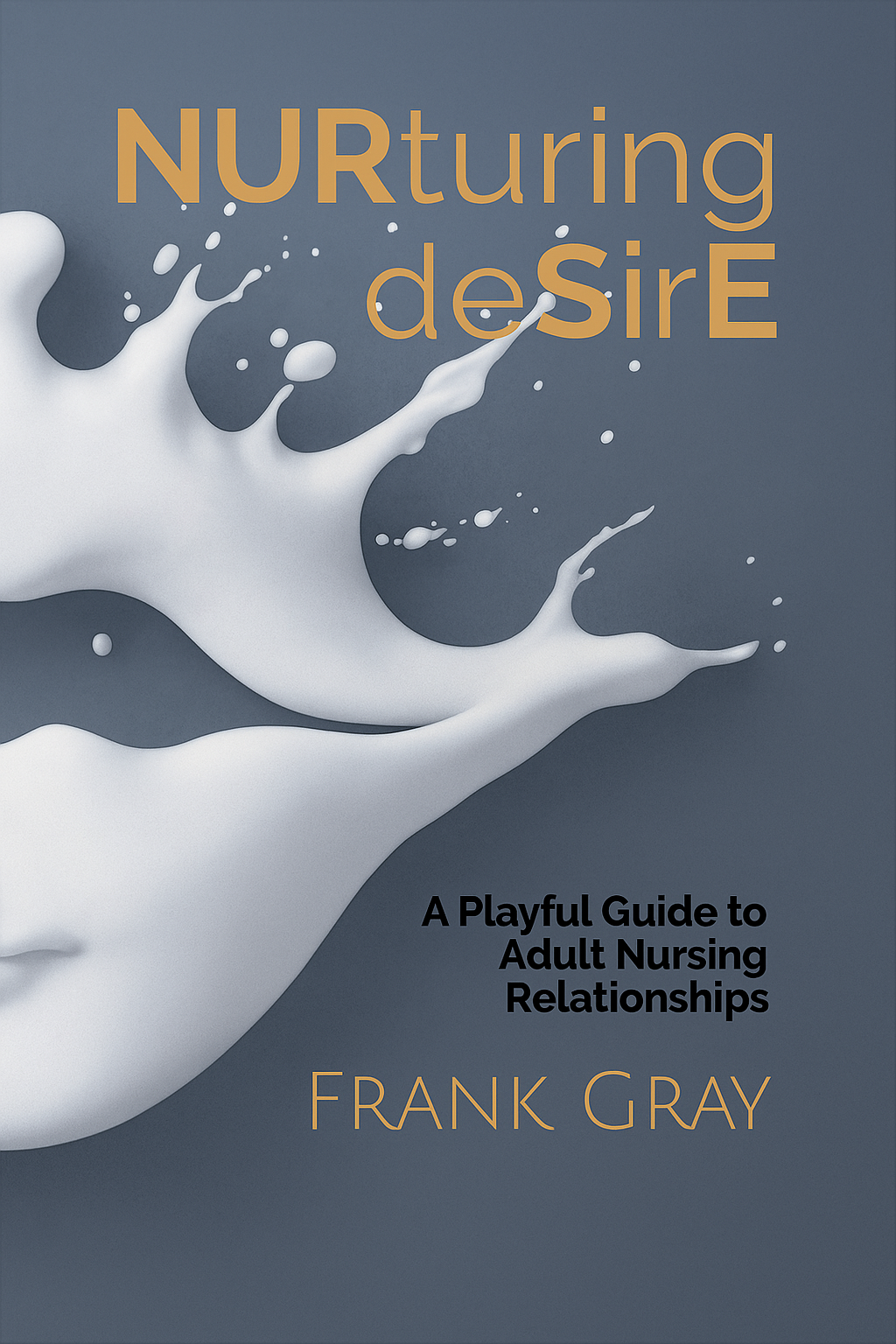
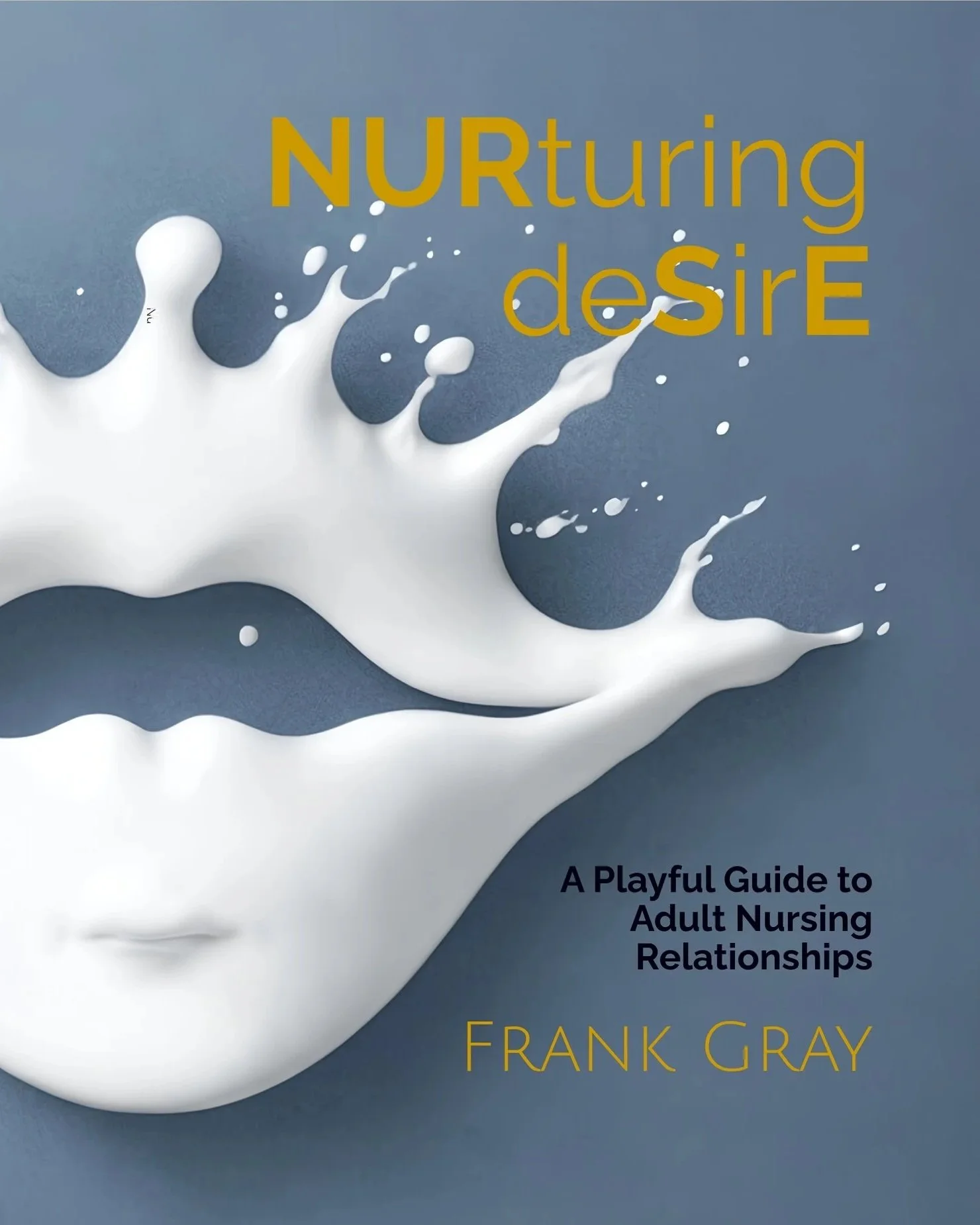

NURturing deSirE: A Playful Guide to Adult Nursing Relationships
By Frank Gray
A thoughtful, intimate exploration of adult nursing relationships (ANR) as a practice of deep connection, co-regulation, and embodied trust between consenting adults. This book invites readers to reconsider how desire, nurture, and intimacy naturally intertwine—framing adult nursing not as fetish or novelty, but as relational practice rooted in comfort, communication, and mutual care.
Through reflective storytelling, grounded psychology, and practical guidance, you'll explore vulnerability, consent, boundaries, and emotional safety—the foundations of any enduring intimacy.
Inside You'll Find:
- Clear, compassionate discussion of adult nursing relationships
- Insight into the emotional and physiological foundations of nurturing touch
- Guidance for talking with a partner about curiosity, desire, and consent
- Exercises and prompts designed to deepen trust and connection
- A tone that is playful, reverent, and deeply human—never clinical or sensational
Written for adults, by adults, centering consent, respect, and emotional maturity throughout.
Whether you're curious, already practicing, or seeking more tender and embodied intimacy in your relationship, NURturing deSirE offers reassurance, clarity, and permission to honor what feels true in your body and your bond.
SIGNED & INSCRIBED EDITION - LIMITED AVAILABILITY
For readers who wish to hold something truly personal, this limited edition includes a hand-signed inscription written especially for you by author Frank Gray. Each copy features a unique, heartfelt message of encouragement, gratitude, or resonance—making your book one of a kind.
Perfect as:
- A meaningful gift for your partner
- A keepsake commemorating the start of your ANR journey
- A tangible symbol of validation and support
- A collector's item for those who connect deeply with the book's message
- Paperback format: 9" × 7"
- Hand-signed by Frank Gray
- Personalized inscription (specify name/message at checkout)
- Ships within 5-7 business days
- $25
This is more than a book—it's an intimate extension of the book's spirit of connection and care, personally crafted for you.