💌 Dear Frank: Letters From the Soft Places (Vol. 1)

A NURturing deSirE Advice Column
Some people arrive at NURturing deSirE because they're curious.
Some arrive because they're lonely.
Some arrive because they've carried a truth for years and finally found a place soft enough to set it down.
I didn't expect this many letters.
Not so quickly. Not so honest. Not so beautifully human.
So here it is: the first installment of Dear Frank, a column for the questions that live beneath the skin, written by the people who found this work at the exact moment their nervous system whispered, "Speak."
Three letters. Three lives. Three very different doors into the same longing for connection.
Let's begin.
📨 Letter 1: "A neuroscientist who needs your poetic translation more than the literature."
Elena — Cambridge, MA
Dear Mr. Gray (Frank),
I study the exact receptor systems you write about so casually—the OXTR polymorphisms, vagal tone, the hippocampal effects of sustained oxytocin release—yet your post on "Oxytocin: The Love Hormone (and Why Nursing Works)" made me feel them in my body for the first time. That has never happened in a lab.
I'm writing because I've begun self-induced lactation in complete solitude after a painful breakup. The physiological protocol is straightforward (I have access to the literature and compounds), but the emotional scaffolding is missing.
Your writing keeps circling the idea that nursing is a co-regulated nervous-system event, not just chemistry. How do you hold that space alone? Are there rituals or mental reframes you've used (or seen partners use) when the mouth at the breast isn't attached to another nervous system in real time?
I can get the milk to flow, but I cannot get the feeling—the soft landing you describe.
I apologize for the clinical tone; it's a shield. Your words feel like the first safe place I've found in years.
Thank you,
Elena
Dear Elena,
You can call me Frank. Especially here.
Your message is one of the most achingly intelligent and tender letters I've received. And your closing line? That did something to me:
"Your words feel like the first safe place I've found in years."
Let's sit with that for a moment.
You've mapped receptor systems and still had to travel here—to a soft, strange little book about nursing—to find safety. That says a lot about what intellect can do... and what it sometimes can't.
So let's talk, human to human. Not just scientist to storyteller.
You Asked: "How do you hold that space alone?"
These are heartbreakingly beautiful questions. And they matter deeply to more people than you know—because there's a quiet wave of folks who've found themselves inducing, exploring, or reclaiming this practice alone.
Not for a partner. Not for a baby. But because something inside them said:
"Let me be held—even if I'm the one doing the holding."
Here's how some of them—and sometimes I—have found that soft landing, even in solitude:
🫀 1. Treat Your Body as Both Lover and Beloved
This sounds poetic. It's also neurological.
The vagus nerve doesn't require another person to be stimulated—it requires safety, rhythm, and warmth. Solo nursing can become a co-regulated event within your own body if you allow it to be.
That means:
Touch yourself as if someone who adored you were touching you.
Don't rush. Don't mechanize. Place your hand on your breast with the tenderness you'd want from a partner. Cup, don't grab. Stroke, don't extract.
Speak aloud—not to yourself as "I," but as "you":
"You're safe."
"You're enough."
"I've got you."
This isn't self-help affirmation. It's nervous system training. Your brain literally processes third-person language differently than first-person—it creates psychological distance that allows self-compassion.
Close your eyes and imagine—not fantasy, but presence.
Not a specific lover. Not a face. Just a witness. Someone who sees you, holds space for you, allows you to be exactly as you are.
You can literally pair the sensation of milk flow with affirming language.
That turns the letdown reflex into a scripted return to safety.
Over time, your body will learn: Milk = I am held.
🕯️ 2. Build Ritual, Not Routine
If this is about more than milk, let the space reflect that.
Before you begin:
Light a candle
Wrap yourself in a specific scent (lavender, sandalwood, something grounding)
Use music (I keep a playlist for nursing specifically)
Dim the room
Hold something weighted against your spine (a heating pad, a pillow, a weighted blanket folded and placed behind you)
Make it holy—not because you're "supposed" to, but because you deserve ceremony.
And if grief rises?
Let it. You're not doing it wrong. You're doing it fully.
Milk and tears often arrive together. Oxytocin opens emotional floodgates—it's not just bonding hormone, it's release hormone.
🌬️ 3. Give the Milk Somewhere to Go
Even if you're not feeding a partner or child, the act of offering can be healing.
Some people:
Express a few drops into warm water and speak a blessing aloud
Write one-word intentions during letdown (gratitude, release, home)
Anoint themselves with a drop on pulse points (wrists, heart, third eye)
Keep a small bowl beside them and watch the milk gather—witnessing its reality
The goal is to remind your system:
"This flow means something. It is witnessed. Even in solitude."
💡 One Very Human Reframe:
When the milk comes and the feeling doesn't, don't assume the process is broken.
Your nervous system may still be thawing.
Sometimes milk precedes meaning.
Let it. Let your body go first. The soul often takes a beat to catch up.
Think of it like this: You're a scientist. You know that lactation is a learned physiological response. Your ducts had to be taught how to produce milk through repeated stimulation.
Your nervous system is learning the same way.
It's being taught, through repetition and safety, that this practice = calm. That letdown = held.
Give it time. Give it consistency. Give it permission to arrive slowly.
Elena, you're doing something radical: inviting nurture into a space that has known loss.
You're not trying to "fill a hole"—you're trying to tend the edges of it.
That's not pathology. That's poetry.
Keep nursing. Keep noticing. And when the day comes that the milk flows and the feeling lands, you'll know:
It wasn't chemistry that changed. It was you. Letting yourself be held.
With reverence,
Frank
P.S. No apology needed for the clinical tone. Shields serve a purpose—especially for brilliant minds trying to tiptoe into softness. You can bring your science here. Just let your heart walk in beside it.
📨 Letter 2: "A first-time wet nursing question from a guy who never thought he'd be writing this."
Marc — Somewhere on I-80
Hey Frank,
Your Milk Drops blog popped up when I was googling "adult breastfeeding without baby" at 3 a.m. in a truck stop outside Billings. Read the Oxytocin piece and the latching piece and damn near started crying in the sleeper cab—didn't expect that.
My girlfriend (long-distance right now) surprised me by starting to lactate for us. First time it happened I froze up—felt like I was doing something wrong even though she was begging me to keep going.
I'm 6'4", bearded, been single for years, and here I am addicted to something that feels more intimate than sex ever did.
Question: when there's actual milk (not just drops), how do you not make it feel… clinical? Like I'm "milking" her instead of loving her? She says it feels amazing, but I catch myself overthinking technique and it kills the mood.
Any tricks from your side for staying in the emotional lane instead of the mechanical one?
Appreciate you putting this out there, man. Makes a guy feel less like a freak.
Marc (Somewhere on I-80 right now)
Oh Marc—
If this ever becomes a book of letters, yours is going right up front.
The image of a 6'4" bearded guy getting misty over oxytocin in a sleeper cab outside Billings? That's not just poetry—that's proof that intimacy sneaks up on us in the most unexpected places.
Thank you for writing. You're not a freak. You're just awake.
Let's Talk About Your Question:
"When there's actual milk... how do you not make it feel clinical? Like I'm 'milking' her instead of loving her?"
God, what a good question. And you're not the only one who's felt that shift—when the body starts giving in a real, visible way, it can be disorienting.
Suddenly, what used to be sensual and slow turns into something that feels more... productive. And that change can trip up even the most emotionally grounded partner.
Here's what I'd offer:
🐄 1. Ditch the Word "Milking." Seriously.
Yes, it's the biological term. But emotionally? That word pulls us out of presence and into function.
You're not milking a cow. You're not pumping a machine.
You're receiving a gift from someone's body because she wants to give it to you.
You're not extracting—you're connecting.
So when the milk flows, try reframing it like this:
"This isn't me making something happen. This is her body choosing to trust me."
Stay in that story.
🐚 2. Focus on Atmosphere, Not Outcome
Technique matters—but tone matters more.
Soften the moment:
Dim the lights
Turn on music
Add warmth to the room (literally and emotionally)
Keep your other hand engaged—not in productivity, but in presence:
Stroke her arm
Hold her hand
Rest on her ribcage
Trace her collarbone
This reminds you both: We're not here to perform. We're here to connect.
If things start to feel too mechanical?
Pause. Kiss her collarbone. Breathe together. Let the milk be part of the moment, not the goal.
🌊 3. Stay Attuned to Rhythm, Not Results
Let her body guide the pace.
Milk tends to flow in waves—not always consistent, not always predictable.
Don't rush it. Let the experience be messy, surprising, even funny.
(Sometimes, a spontaneous spurt hits your chin. Laugh. Wipe it. Keep going.)
This isn't a job. It's a dance.
Sometimes she leads. Sometimes you do. But the music is trust.
🫶 4. Own Your Reaction
You froze the first time because you care.
That's not failure—it's reverence.
Your pause didn't mean "something's wrong." It meant you realized something was real.
That tenderness? Let it stay.
Let it inform:
How you hold her
How you drink from her
How you thank her—verbally or not—for offering herself this way
Marc, the fact that you're asking this question means you're already doing it right.
Staying "in the emotional lane" isn't about being perfect—it's about choosing presence over performance, again and again.
So next time the milk flows, try this:
Don't think "Am I doing this right?"
Think "Can she feel how much I love being close to her?"
That's the real technique. Everything else is just gravity and skin.
Keep trucking. And stay in touch when you can—I'd love to hear how this grows.
With grit and gratitude,
Frank
📨 Letter 3: "Thank you + a very specific question about induced lactation."
Sarah — Toronto
I found your site through the "Dry vs. Wet Nursing" post yesterday and ended up reading everything in one sitting with tears in my eyes; someone finally wrote the words I've never been able to say out loud.
My husband and I have been nursing (dry) almost every night for comfort and closeness. It's the best part of our marriage, but I keep circling the idea of actually bringing in milk someday.
I'm turning 35 soon and we're not sure about kids yet, so the idea of inducing just for us feels both exciting and terrifying. Every forum I've found is either fetish-focused or written for new moms. Your writing feels safe and human.
My question is brutally practical: once I actually start a serious induction protocol (I have the Domperidone prescription ready), how did you and your partner handle the first few weeks when the milk is unpredictable and sometimes just a few drops? Did you ever feel silly or discouraged?
How did you protect the emotional side of nursing when the physical reality was messy and slow?
I ordered the paperback tonight. Thank you for giving this beautiful thing a name that doesn't make us feel broken.
With gratitude,
Sarah (Toronto)
Dear Sarah,
First of all, thank you. Your note stopped me in my tracks.
The care and courage in your words—that is exactly why this work exists.
You're not broken, not alone, and certainly not the first person to feel both awe and hesitation about crossing into something so intimate and undefined.
You Asked:
"How did you and your partner handle the first few weeks when the milk is unpredictable and sometimes just a few drops?"
Such a beautifully honest question.
And here's the truth: many couples who explore induced lactation describe those early days as surprisingly emotional.
You do the prep. You follow the plan. And then... a drop. Maybe.
It can feel anticlimactic, even a little absurd. One person told me, "I expected magic—and I got moisture." It was said with love and laughter, but also with real vulnerability.
What Helps Most?
1. Reframe Those Early Drops
They're not a finish line—they're a signal.
A "hey, I hear you" from your body.
For some, that's cause for celebration. (I know one couple who literally toasted their first drop with a shot of almond milk.)
The first drop is proof:
Your body is listening
The protocol is working
The impossible is becoming possible
That deserves acknowledgment, not disappointment.
2. Make Emotional Connection the Metric
Not ounces. Not volume.
But questions like:
Did we feel close tonight?
Did we breathe better afterward?
Did we laugh together?
Did I feel held?
Keeping the soul of nursing intact protects it from becoming mechanical.
3. Stay Playful
The couples who thrive through induction tend to be the ones who:
Laugh easily
Take breaks when needed
Refuse to see this as a performance
(Let me just say: the most memorable letdown I ever witnessed came in the middle of a lazy afternoon—not during a "serious session." The body has its own sense of timing.)
4. Celebrate Milestones Beyond Milk
Week 1: You committed to the protocol
Week 2: You felt nipple sensitivity increase
Week 3: You noticed breast fullness
Week 4: First drop appeared
Week 6: Letdown reflex triggered
Week 8: Sustained flow during session
Each of these is worth honoring.
Protecting the Emotional Side When the Physical Reality Is Messy:
Here's my advice:
Continue dry nursing alongside the induction protocol.
Don't wait for milk to appear before you nurse. Keep your nightly ritual exactly as it is—warm, intimate, comforting.
When the milk arrives, it will join what's already working, not replace it.
That way, even on nights when production is low or unpredictable, you still have the core intimacy that brought you here.
The milk is the bonus. The connection is the point.
Sarah, you already have the most important thing: a bond worth deepening.
The milk will come (or it won't—and that's okay too).
But the practice of holding each other, breathing together, ritualizing intimacy in a touch-starved world?
That's already revolutionary.
With warmth,
Frank
Frequently Asked Questions About Starting Adult Nursing
How do I start adult nursing with my partner?
Start with conversation, not technique. Share your interest honestly: "I've been curious about nursing as intimacy. Would you be open to exploring this together?" Create ritual (dim lights, warm space, music), begin with touch before latching, expect awkwardness initially, and communicate throughout. Laughter and curiosity matter more than perfection.
Can you induce lactation without being pregnant?
Yes. Induced lactation requires:
Consistent nipple stimulation (nursing or pumping 2-3x daily minimum)
Galactagogue herbs (fenugreek, blessed thistle, fennel)
Proper hydration and nutrition
Patience—results typically take 3-6 months
Optional: Domperidone (prescription, under medical supervision)
Consulting a lactation specialist helps optimize protocols for individual bodies.
How long does it take to induce lactation?
Induced lactation timelines vary widely: some people see drops within weeks, others need 3-6 months of consistent stimulation. Factors include hormone levels, frequency of stimulation, body responsiveness, stress levels, and previous lactation history. Patience and consistency matter more than intensity—slow, sustained effort wins.
Is adult nursing safe?
Adult nursing is safe for most people when both partners are healthy and communicate openly about health and boundaries. Avoid nursing if either partner has transmissible infections. If inducing lactation with medications (like Domperidone), consult a healthcare provider familiar with lactation protocols. The practice itself carries minimal physical risk when practiced with consent and awareness.
What if nursing feels awkward at first?
Awkwardness is completely normal. Like any new intimacy, there's a learning curve—most couples report the strangeness fades within 2-3 sessions once you find your rhythm. Laugh together, communicate openly, and don't treat it as performance. Curiosity over perfection. The comfort comes with repetition, not immediate mastery.
💬 Closing Thoughts: The Door Is Open
If you saw yourself in any of these letters—write to me.
Shy. Scientific. Heartbroken. Curious.
Anonymous or not. Signed or initialed.
It all counts.
The door of NURturing deSirE is open to the questions most people keep hidden.
Send your letter:
📧 therealfrankgray@gmail.com
Subject line: "Dear Frank"
I can't promise to answer every letter publicly, but I read every single one.
And sometimes, the act of writing it down—of naming what you've never named—is the first soft landing you need.
Continue exploring:
📖 NURturing deSirE — The comprehensive guide to adult nursing relationships
🎨 The Milky Way — Weekly comics about milk spirits and intimacy
💧 Milk Drops — Essays on biology, desire, and connection
With warmth,
Frank Gray
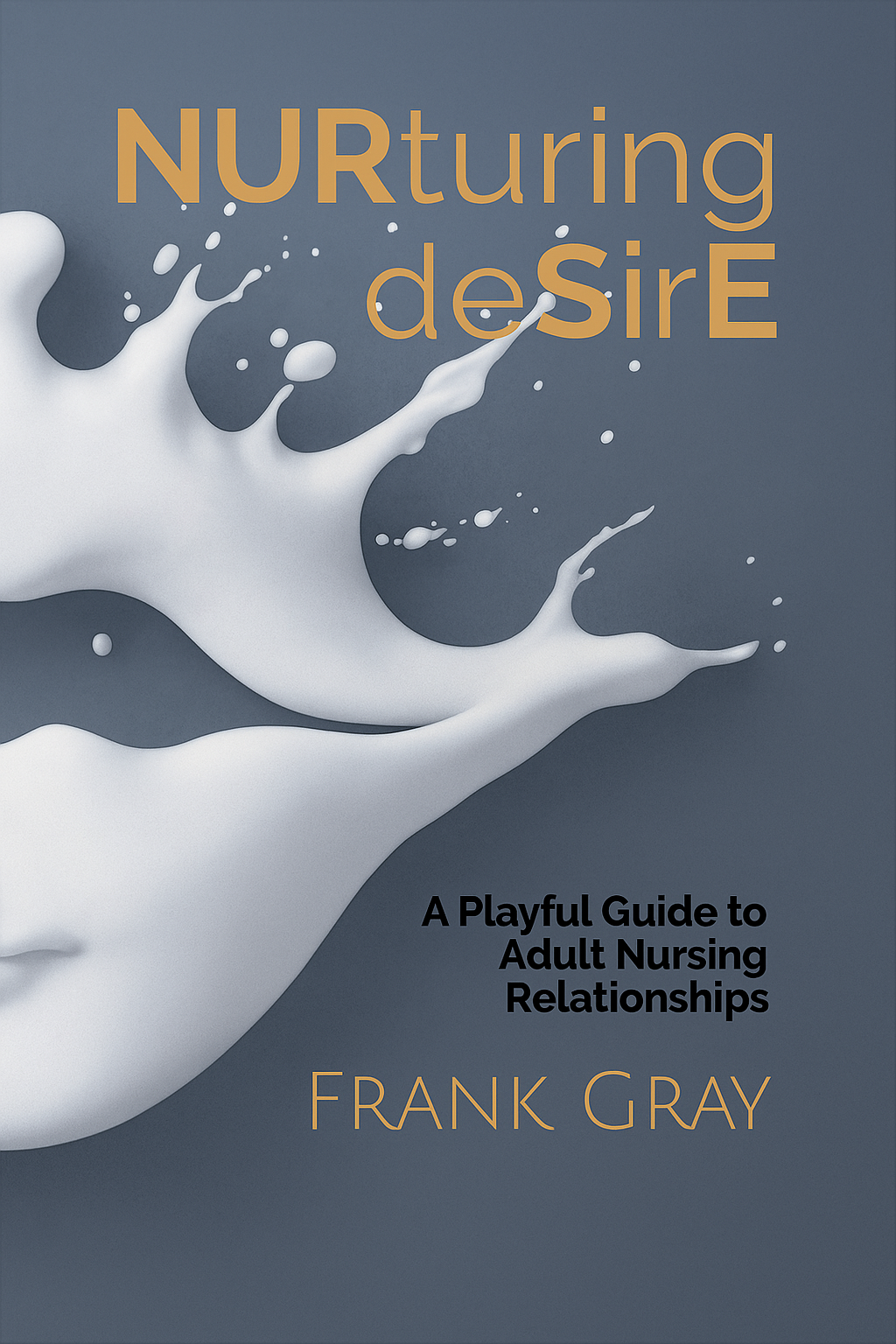

NURturing deSirE: A Playful Guide to Adult Nursing Relationships
By Frank Gray
A thoughtful, intimate exploration of adult nursing relationships (ANR) as a practice of deep connection, co-regulation, and embodied trust between consenting adults. This book invites readers to reconsider how desire, nurture, and intimacy naturally intertwine—framing adult nursing not as fetish or novelty, but as relational practice rooted in comfort, communication, and mutual care.
Through reflective storytelling, grounded psychology, and practical guidance, you'll explore vulnerability, consent, boundaries, and emotional safety—the foundations of any enduring intimacy.
Inside You'll Find:
- Clear, compassionate discussion of adult nursing relationships
- Insight into the emotional and physiological foundations of nurturing touch
- Guidance for talking with a partner about curiosity, desire, and consent
- Exercises and prompts designed to deepen trust and connection
- A tone that is playful, reverent, and deeply human—never clinical or sensational
Written for adults, by adults, centering consent, respect, and emotional maturity throughout.
Whether you're curious, already practicing, or seeking more tender and embodied intimacy in your relationship, NURturing deSirE offers reassurance, clarity, and permission to honor what feels true in your body and your bond.
SIGNED & INSCRIBED EDITION - LIMITED AVAILABILITY
For readers who wish to hold something truly personal, this limited edition includes a hand-signed inscription written especially for you by author Frank Gray. Each copy features a unique, heartfelt message of encouragement, gratitude, or resonance—making your book one of a kind.
Perfect as:
- A meaningful gift for your partner
- A keepsake commemorating the start of your ANR journey
- A tangible symbol of validation and support
- A collector's item for those who connect deeply with the book's message
- Paperback format: 9" × 7"
- Hand-signed by Frank Gray
- Personalized inscription (specify name/message at checkout)
- Ships within 5-7 business days
- $25
This is more than a book—it's an intimate extension of the book's spirit of connection and care, personally crafted for you.