Across the Quiet Stars: A History of Milk and Desire




















Bring ancient mythology into your home with this celestial wall art depicting milk as the cosmic substance it truly is. Perfect for meditation spaces, bedrooms, or anyone drawn to spiritual artwork rooted in Greek and Egyptian mythology.
This is what the ancient world knew: milk isn't just biological—it's universal. The same substance that nourishes infants connects galaxies. Milk is stardust made liquid, cosmic matter flowing between bodies made of the same atoms that built the universe.
Two figures suspended in space, throats exposed, drinking starlight. This isn't nursing—this is communion with the infinite. Hair dissolves into nebulae. Skin becomes constellation. The milk flowing between them isn't just theirs—it's the Milky Way itself, the great river of light our ancestors saw stretching across the night sky and named after the very substance that kept their children alive.
The Greeks knew: The Milky Way formed when Hera's breast milk sprayed across the heavens. Egyptians knew: Isis nursed Horus with celestial milk that granted divinity. Every culture that looked up knew: milk and cosmos are one substance wearing different forms.
This artwork reclaims that ancient knowing. When you nurse, you're not just feeding—you're channeling the same creative force that births stars, builds galaxies, and holds the universe together. You're participating in the oldest ritual there is: matter sharing itself with matter, bodies recognizing they're made of the same stuff, connection revealing that separation was always illusion.
Cosmic Milk: Because the distance between breast and mouth is no different than the distance between star and star. It's all gravity, all grace, all the same substance flowing in circles that never end.
Perfect For:
- Meditation room wall art honoring cosmic consciousness
- Bedroom decor celebrating mythological wisdom
- Home office art for astronomy and mythology enthusiasts
- Spiritual gifts for those who see the sacred in the everyday
Premium Museum-Quality Canvas:
- 1.25″ thick gallery-wrap
- Premium poly-cotton blend fabric (10.15 oz/yd²)
- Fade-resistant archival inks
- Hand-stretched over solid wood stretcher bars
- Mounting brackets included—ready to hang
- Available in 5 size tiers: XS (6×6-8×12) $40, S (9×12-12×12) $55, M (12×16-16×20) $75, L (16×24-18×24) $105, XL (18×26-24×36) $145
- Made-to-order to reduce waste
Custom-made when you order. Ships from USA, Canada, Europe, UK, or Australia.

Long before taboos settled over the body like dust, milk was revered as life itself—elixir of healing, gateway to divinity, quiet promise of immortality. In ancient stories, goddesses offered their breasts not only to infants but as portals to wisdom, strength, and rebirth. Their milk was cosmic, generative, uncontained. It spilled across the heavens and nourished gods and mortals alike.
These tales feel distant now, yet when I sit with the letters that arrive in my quiet inbox—lovers describing the warmth of a partner's milk, the slow exhale of nervous systems surrendering together—I sense the same reverence echoing through time.
The history of adult nursing spans millennia, not decades. What we now call adult nursing relationships existed long before the term was coined, woven into the sacred practices of cultures that understood milk as more than nutrition—milk as divinity, power, transformation.
Let us wander through a few of these ancient whispers.
Isis Lactans: Milk as Divine Protection
Isis, great mother of Egypt, was often shown seated, serene, nursing her son Horus. But her milk carried deeper power: it healed, it protected, it granted eternal life. Pharaohs sought to drink from her essence, believing it would make them divine.
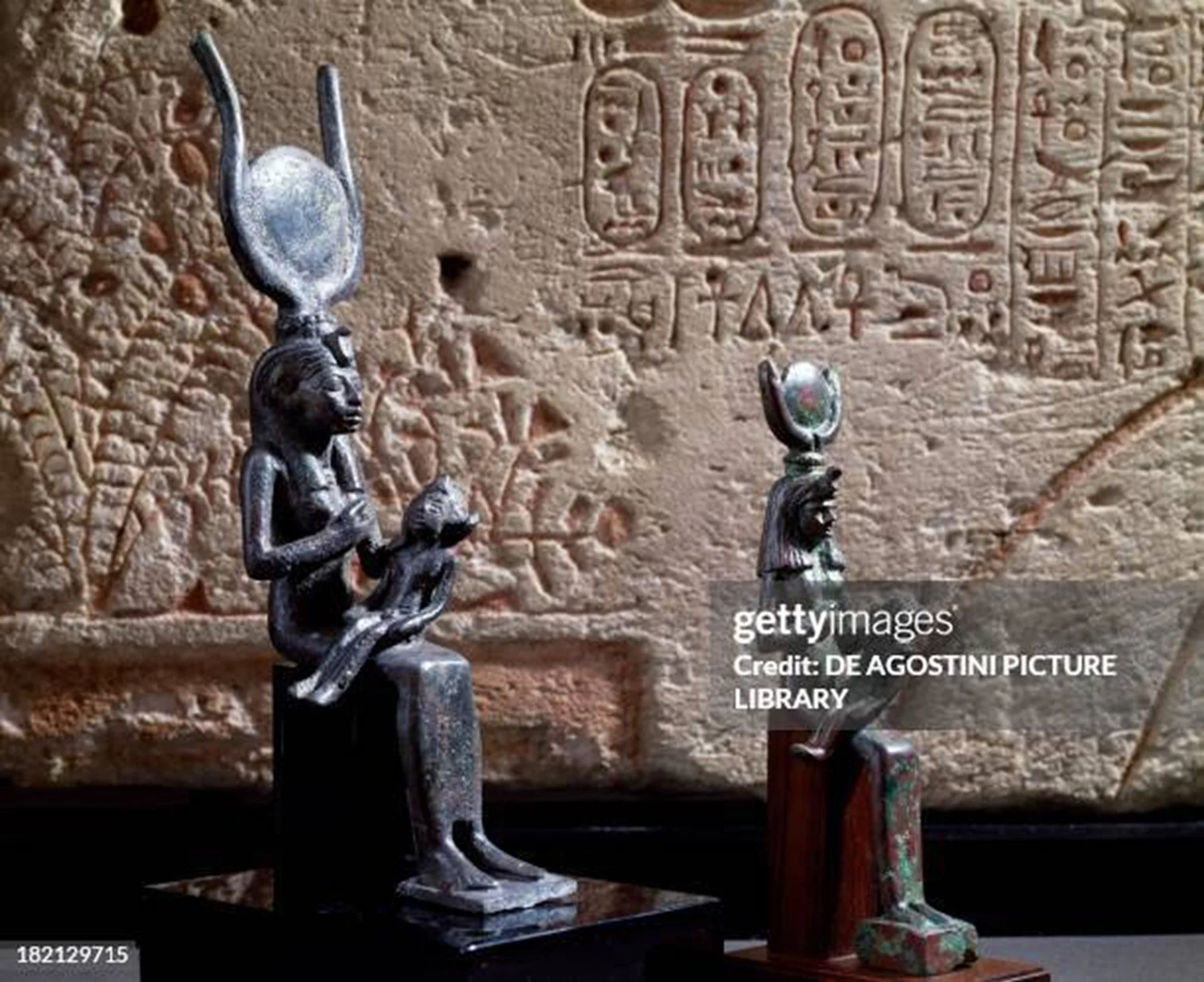
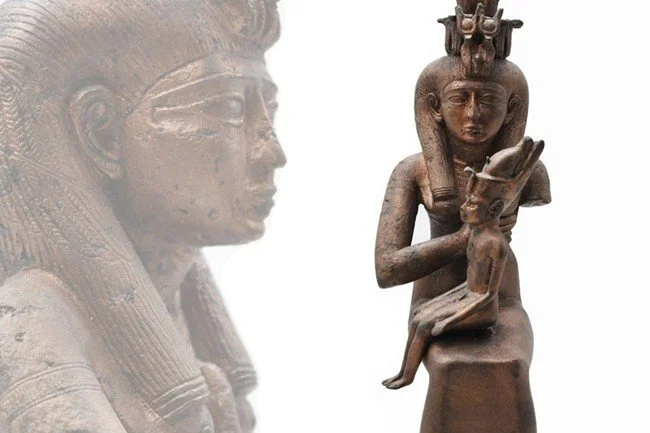
In these bronze and stone figures, Isis Lactans gazes forward with calm authority, her breast offered freely—an image copied across centuries, even into early Christian icons of Mary nursing Jesus.
The connection between divinity and breastfeeding wasn't metaphorical—it was literal theology. Ancient Egyptians believed that consuming divine milk granted access to immortality, wisdom, and protection. Adult rulers sought this nourishment not as regression but as spiritual elevation.
This mirrors what modern practitioners of adult nursing relationships describe: milk as more than physical sustenance. Milk as connection to something larger, something that transcends the ordinary boundaries of intimacy.
Hera and the Birth of the Milky Way
Hera, queen of the Greek gods, once nursed the infant Heracles in a moment of mercy (or trickery, depending on the telling). When she discovered his true identity, she pulled away suddenly, and her milk arced across the sky—becoming the Milky Way we still look up at tonight.
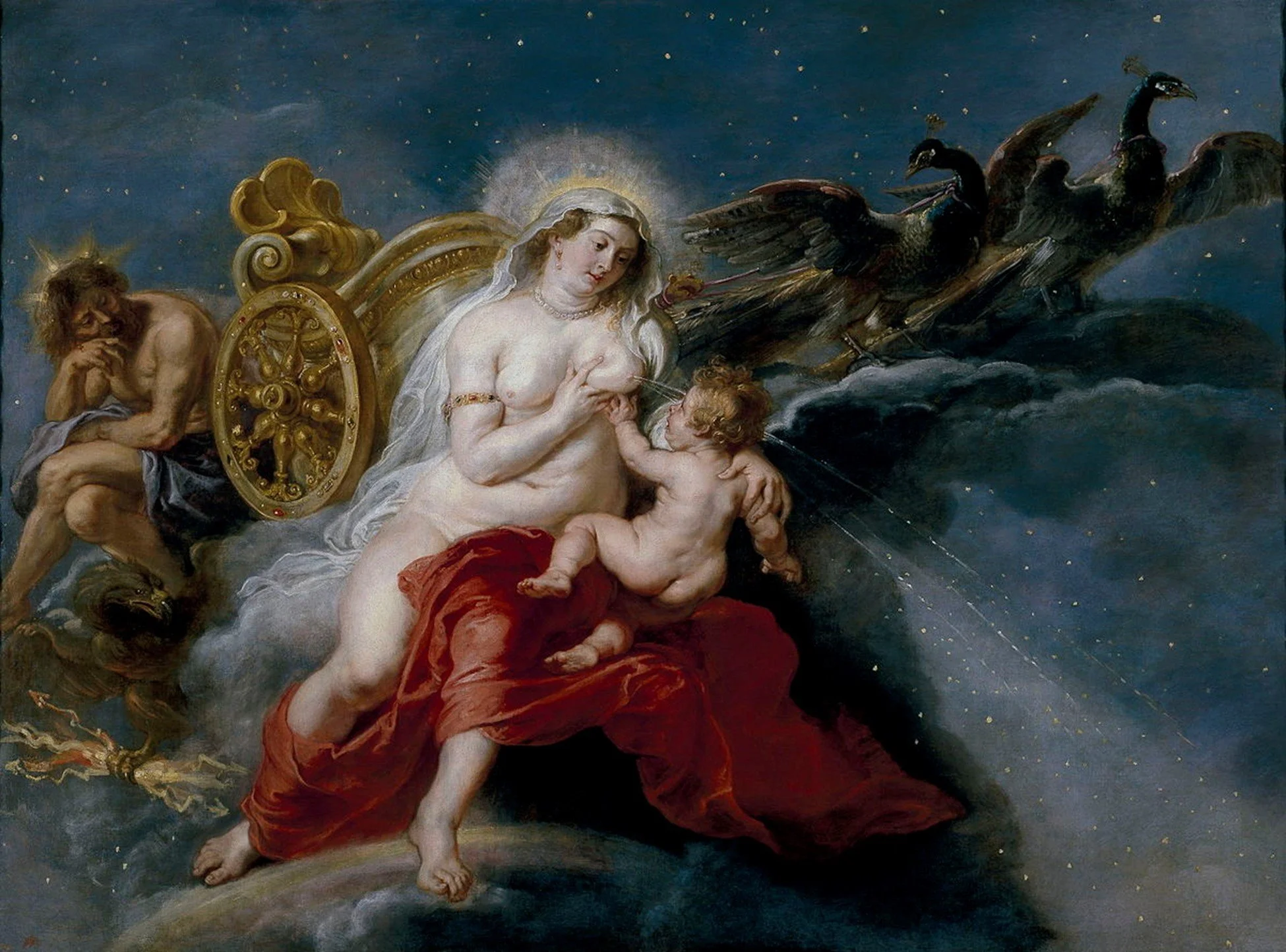
Peter Paul Rubens captured this origin story in swirling, luminous paint: Hera's milk spraying outward like stars being born, peonies blooming beneath her, the galaxy itself a divine let-down.
The Greeks understood what lactation biology confirms: milk doesn't flow on command—it releases. The "letdown reflex" isn't under conscious control; it's triggered by oxytocin, by trust, by the body's assessment of safety. Hera's milk becoming the cosmos is poetry, yes—but it's also physiology made myth.
Hathor: Milk as Celestial Abundance
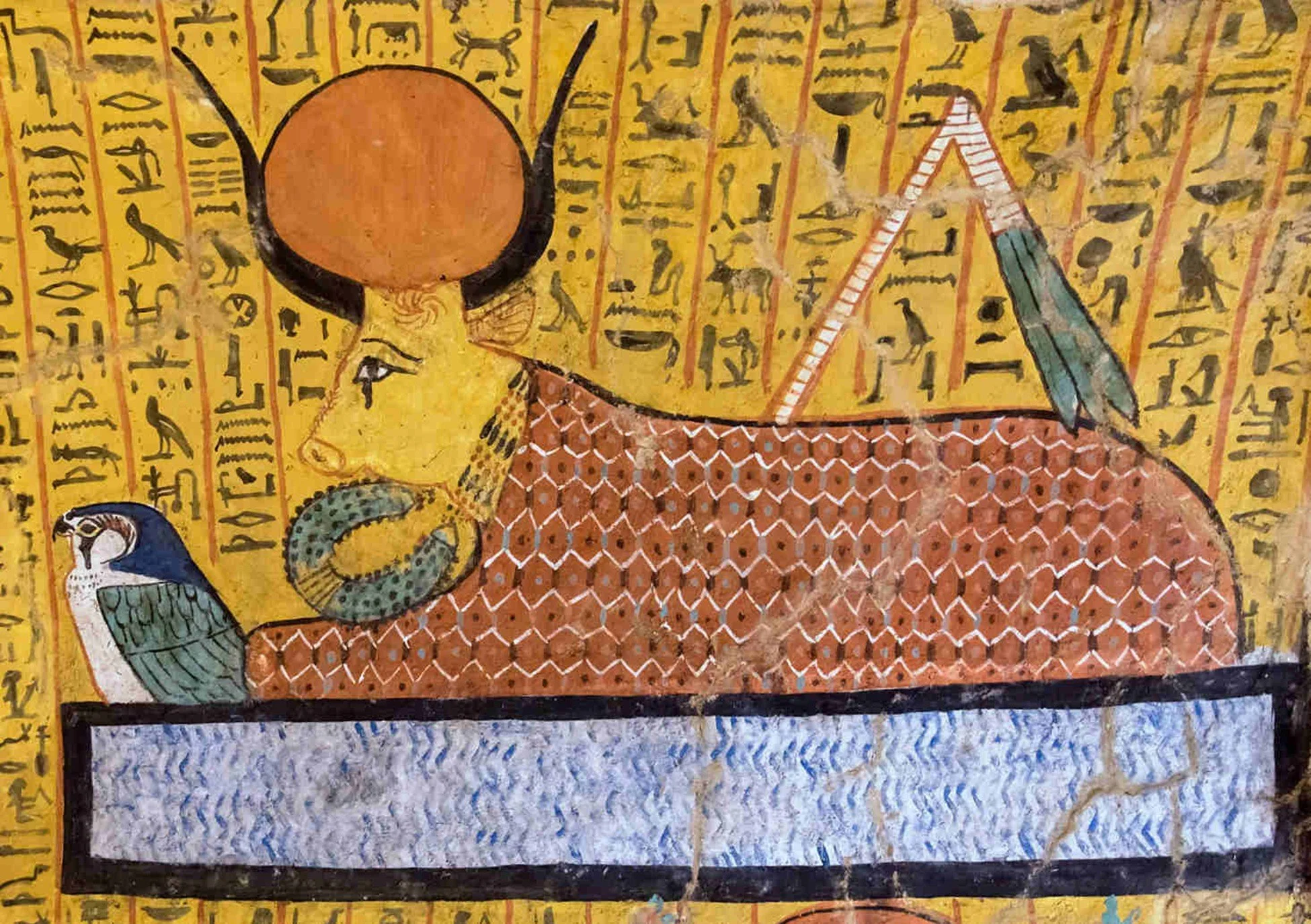
Hathor (and her cow-formed aspect Hesat) embodied sky, love, music, and nourishment. Depicted with bovine horns cradling the sun, or as a gentle cow suckling the pharaoh, she reminded Egypt that milk was celestial—literally the flood of the Nile, the abundance of life.
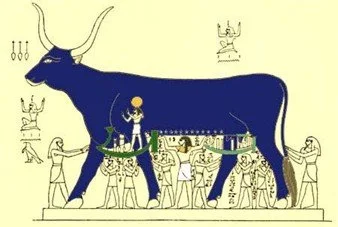
Egyptian pharaohs were depicted nursing from Hathor not as infants but as adults—receiving divine nourishment that legitimized their rule and connected them to cosmic order. This wasn't infantilization. This was ritual, power, and sacred intimacy combined.
The parallels to modern adult nursing practices are striking. Partners describe nursing not as dependency but as chosen vulnerability, as accessing a form of care and connection that our culture has largely abandoned.
Artemis of Ephesus: The Many-Breasted Abundance
Artemis of Ephesus, the many-breasted one, stood adorned with what scholars debate—breasts, bull testicles, or ritual gourds?—yet the message was unmistakable: overflowing fertility, boundless giving.
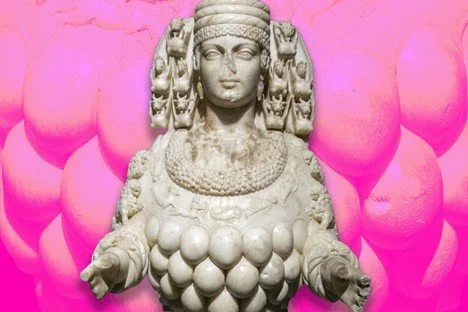
Her temple was one of the Seven Wonders, a place where pilgrims came to touch abundance itself.
Whether the protrusions were breasts, symbols of sacrificed animals, or date clusters, the iconography communicated limitless nourishment. Artemis didn't offer one breast to one child—she offered abundance to entire communities, to the world itself.
This vision of milk as communal resource, as overflow rather than scarcity, challenges modern Western anxieties about milk production and supply. The body that produces milk doesn't hoard it—it offers it freely when conditions of safety and trust are met.
Rumina: The Forgotten Protector
Even lesser-known Rumina, Roman protector of nursing mothers (human and animal alike), received offerings of milk poured beneath her sacred fig tree. No grand statues remain, but her name lingers in our word "ruminate"—to chew over, to digest slowly, like nourishment taken in.
Rumina's worship was quiet, domestic, unglamorous—which is perhaps why it vanished from the grand mythological narratives. But her name surviving in our language tells us something: nourishment requires slow processing, repeated return, the kind of patient care that long-term nursing relationships understand.
To ruminate is to re-chew, to extract maximum nourishment from what's already been consumed. This is precisely how adult nursing works as ongoing practice—not a single act but a sustained ritual of return, deepening, patient extraction of comfort and connection.
Sophia and the Milk of Wisdom
In Gnostic texts, Sophia's milk was wisdom itself, flowing to awaken the sleeping spark in humanity. Milk wasn't just food—it was gnosis, direct knowing, the dissolution of ignorance.
This theological framework positioned breastfeeding as epistemological—milk as the medium through which consciousness expands and truth is transmitted. The one who nursed wasn't merely feeding a body; they were awakening a soul.
Modern practitioners of adult nursing relationships often describe something similar: a shift in consciousness during nursing sessions, a dissolution of ego boundaries, access to states of awareness that feel both ancient and immediate. The oxytocin released during nursing creates this neurochemical opening—what the Gnostics might have called grace, we now understand as nervous system regulation and attachment bonding.
The Continuity: From Ancient Goddesses to Modern Bedrooms
These stories and images do not belong only to museums. They whisper permission: milk shared between lovers is an echo of the divine—nurturing body, spirit, and bond.
When one partner induces lactation, when another drinks deeply in the quiet hours, when desire rises alongside the slow drip of colostrum or mature milk—they are continuing an ancient practice of sacred exchange.
The difference is context, not essence. Ancient cultures embedded milk-sharing in public ritual and religious iconography. Modern couples practice it in private bedrooms, often without cultural scaffolding or community recognition. But the fundamental human impulse—to give and receive nourishment beyond infancy, to use the body's capacity for milk as a medium of intimacy—remains unchanged.
Queer couples practicing adult nursing, male partners receiving milk, long-term partnerships rediscovering nursing after decades—all are writing themselves into this ancient story, whether they know the mythology or not.
New Myths for a Touch-Starved World
In modern poetry and quiet art reclaimed today, lovers write their own verses: milk as devotion, as homecoming, as revolution against a touch-starved world.
We are writing new myths now, in bedrooms lit by low lamps, in the hush after a long latch. The milk spirits of my comics—those luminous, shape-shifting drops—dance in the same lineage. They spill, they float, they nourish without asking for pedigree or permission.
What myths do we write when we nurse one another today?
Perhaps ones gentler than the old thunderous tales. Perhaps ones where the galaxy is born not in rejection, but in the slow, chosen surrender of one body to another. Perhaps ones where milk isn't seized as divine right but offered as gift, received as grace.
The ancient goddesses commanded temples and shaped empires. Modern nursing partners create sacred space in studio apartments and suburban bedrooms. The scale has changed. The sanctity hasn't.
Milk Across Time
Milk has its own way of traveling. Desire does too. Where one goes, the other usually follows—across centuries, across skin, across the quiet stars we make together.
From Isis to Hera to Hathor to Artemis to Rumina to Sophia—and now to the couples writing to me, sharing their stories of induction protocols and first letdown and the radical intimacy of choosing to nurture each other through milk—the thread remains unbroken.
We are not inventing adult nursing. We are remembering it.
The goddesses knew. The body knows. The milk spirits know.
All that remains is for us to stop forgetting.
For those ready to reclaim milk as sacred practice, NURturing deSirE offers both historical context and practical guidance for bringing ancient wisdom into modern intimacy.
With warmth,
Frank Gray
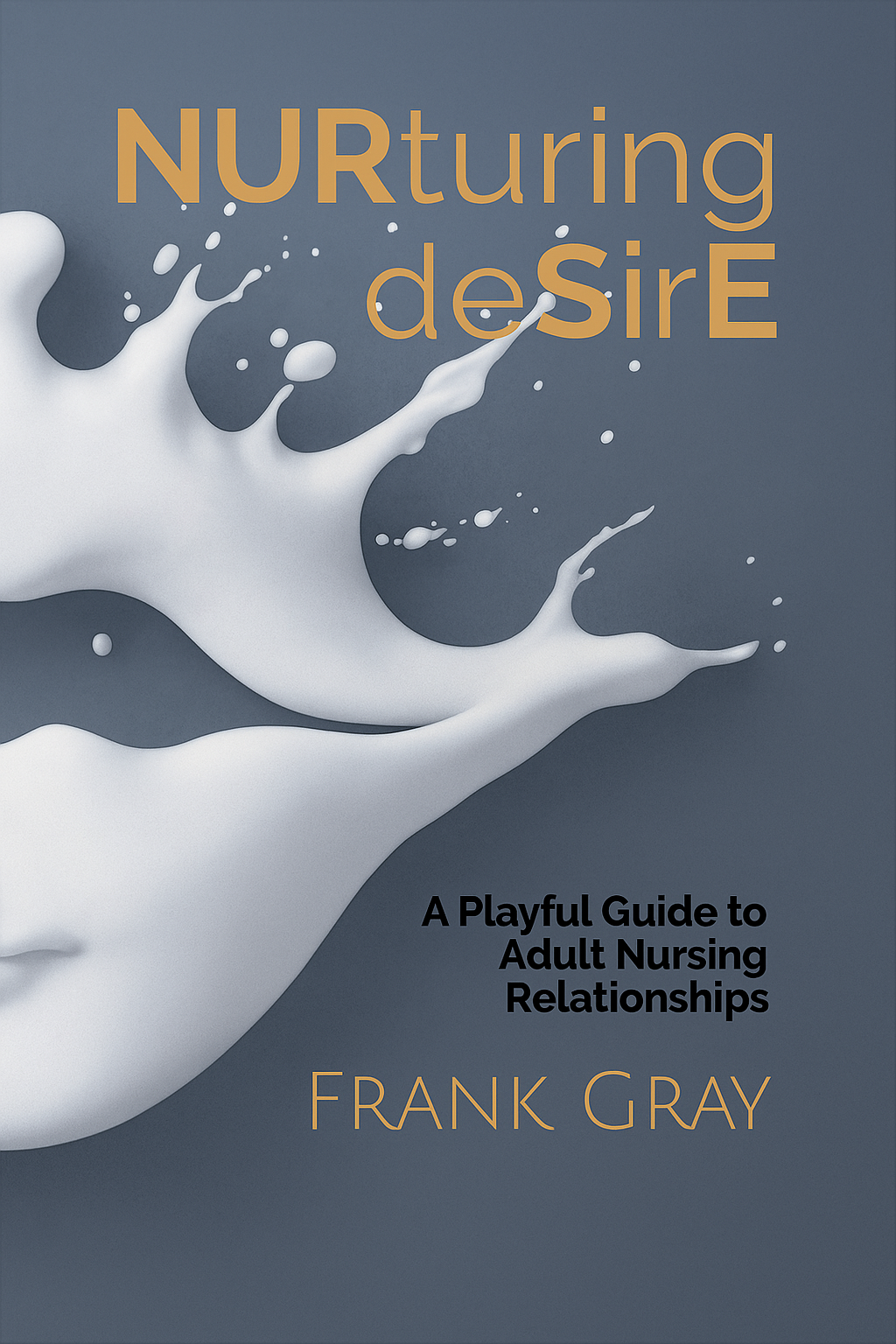
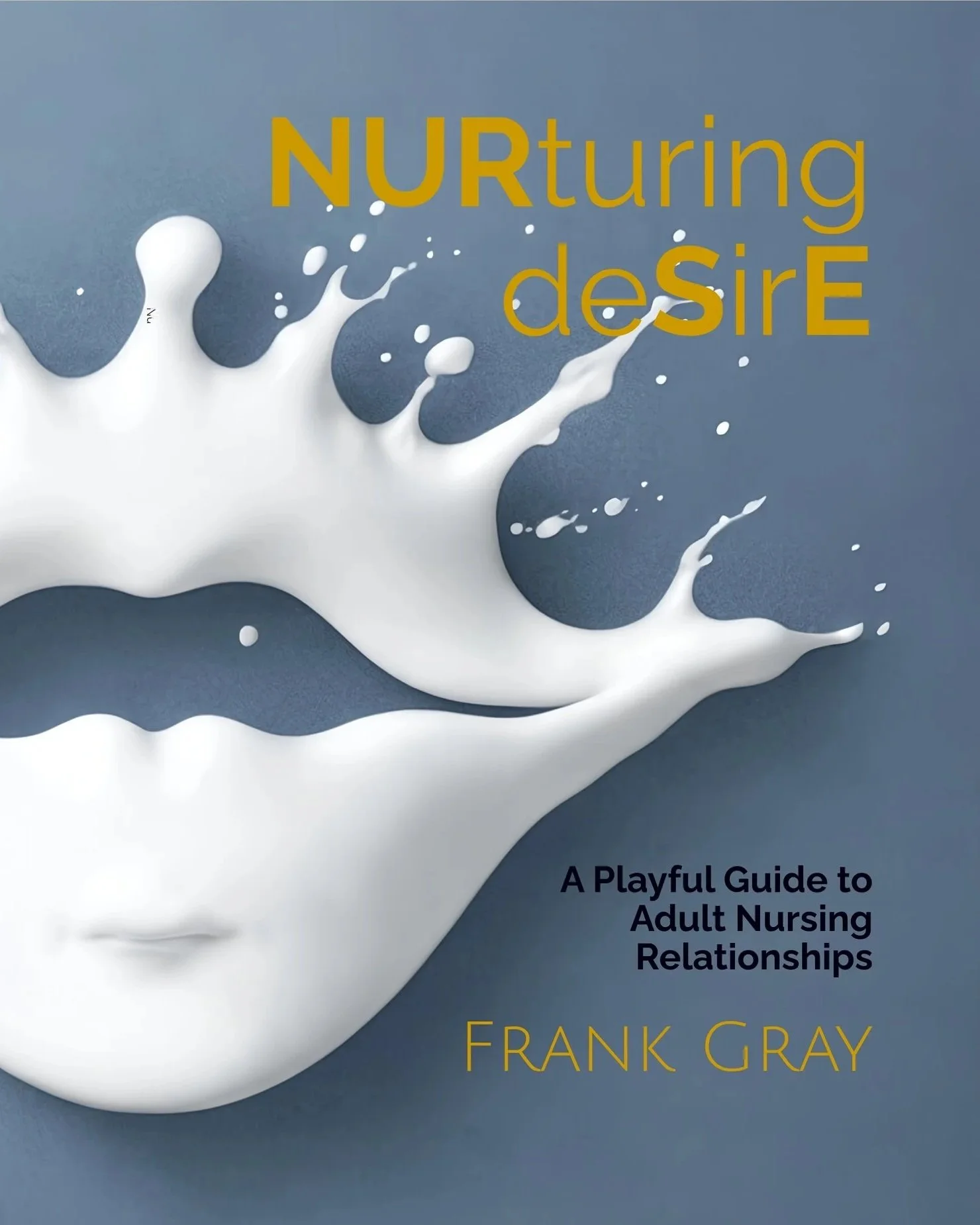

NURturing deSirE: A Playful Guide to Adult Nursing Relationships
By Frank Gray
A thoughtful, intimate exploration of adult nursing relationships (ANR) as a practice of deep connection, co-regulation, and embodied trust between consenting adults. This book invites readers to reconsider how desire, nurture, and intimacy naturally intertwine—framing adult nursing not as fetish or novelty, but as relational practice rooted in comfort, communication, and mutual care.
Through reflective storytelling, grounded psychology, and practical guidance, you'll explore vulnerability, consent, boundaries, and emotional safety—the foundations of any enduring intimacy.
Inside You'll Find:
- Clear, compassionate discussion of adult nursing relationships
- Insight into the emotional and physiological foundations of nurturing touch
- Guidance for talking with a partner about curiosity, desire, and consent
- Exercises and prompts designed to deepen trust and connection
- A tone that is playful, reverent, and deeply human—never clinical or sensational
Written for adults, by adults, centering consent, respect, and emotional maturity throughout.
Whether you're curious, already practicing, or seeking more tender and embodied intimacy in your relationship, NURturing deSirE offers reassurance, clarity, and permission to honor what feels true in your body and your bond.
SIGNED & INSCRIBED EDITION - LIMITED AVAILABILITY
For readers who wish to hold something truly personal, this limited edition includes a hand-signed inscription written especially for you by author Frank Gray. Each copy features a unique, heartfelt message of encouragement, gratitude, or resonance—making your book one of a kind.
Perfect as:
- A meaningful gift for your partner
- A keepsake commemorating the start of your ANR journey
- A tangible symbol of validation and support
- A collector's item for those who connect deeply with the book's message
- Paperback format: 9" × 7"
- Hand-signed by Frank Gray
- Personalized inscription (specify name/message at checkout)
- Ships within 5-7 business days
- $25
This is more than a book—it's an intimate extension of the book's spirit of connection and care, personally crafted for you.